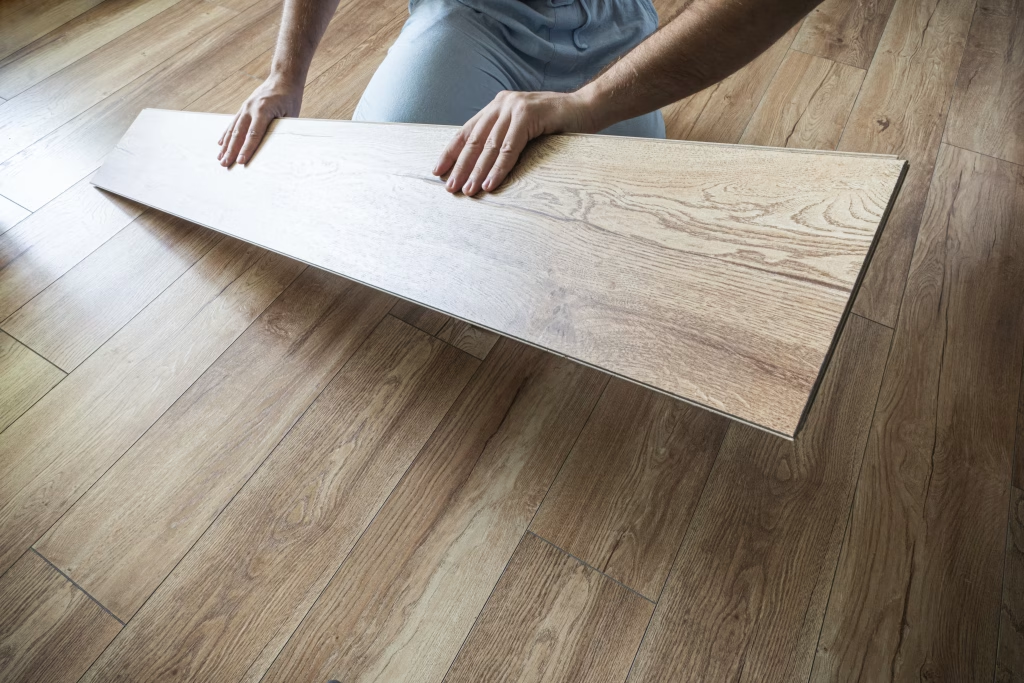
If you've been looking at flooring for a Dubai property recently, you've almost certainly encountered SPC. Stone Plastic Composite flooring has gone from a specialist product to the default choice in Dubai renovations over the last several years — and the reasons are specific to how the UAE climate treats floors, not just general marketing claims about durability.
This guide covers everything you need to know: what SPC actually is (including the layer structure that makes it work), why the UAE climate specifically favours it over laminate and standard vinyl, how to choose the right thickness for your space, what installation over existing tiles involves, and what it costs in AED with professional installation included. Our full SPC flooring Dubai range is there when you're ready to look at options — but read this first and you'll make a better choice.
1. What SPC Flooring Actually Is — And How the Layers Work
SPC stands for Stone Plastic Composite. The name describes the core: a rigid layer made by combining limestone powder with PVC resin and stabilizers under heat and pressure. That core is what makes SPC fundamentally different from standard vinyl flooring — it's not just plastic, it's plastic reinforced with stone, producing a plank that doesn't flex, doesn't absorb water, and doesn't move meaningfully with temperature changes.
The plank itself has a distinct layer structure. Understanding the layers helps you make sense of the specifications you'll see quoted — particularly wear layer thickness, which is the single most important spec for durability.
When comparing SPC options, focus on wear layer thickness first, total thickness second. A 6mm plank with a 0.2mm wear layer will wear out faster than a 5mm plank with a 0.5mm wear layer — the extra total thickness is in the core, which adds rigidity and acoustic performance but not surface durability. Wear layer is what determines how long the floor looks good under traffic.
2. Why SPC Is the Right Choice for Dubai's Climate
Every flooring type works in a moderate climate with stable temperatures and low humidity variation. Dubai's climate is not that. It tests flooring in ways that reveal weaknesses that temperate-climate performance data doesn't predict. SPC's design happens to address the three specific things that fail other flooring types in UAE conditions.
Temperature Cycling Resistance
Dubai's apartments experience extreme temperature cycling — surface temperatures reaching 60°C+ on south-facing balcony-adjacent floors in summer, against heavily air-conditioned interior temperatures of 20–22°C. This cycling expands and contracts flooring materials by different amounts. Laminate's wood-fibre core expands significantly; WPC expands less but still measurably. SPC's limestone-PVC core changes by less than 0.10% across this full range — tested to EN ISO 23999. That's why SPC floors don't gap at the joints or buckle in Dubai's conditions the way laminate often does.
Complete Waterproofness
Dubai apartments have tiled kitchens and bathrooms for a reason — water destroys most floor materials. But SPC's waterproofness is different from a tile's: it's not just the top surface, it's every layer including the core. A spill that sits on SPC for hours causes no damage. A flooded bathroom floor won't cause the SPC to swell, delaminate, or warp. This makes SPC the only flooring type that can be installed continuously across kitchen, bathroom, and living areas without transitional changes.
UAE Dust and Sand Hardness
Dubai's fine sand and dust is abrasive — it's essentially fine silica that acts as sandpaper under foot traffic. This is harder on floor surfaces than the domestic dust found in temperate climates. SPC's UV-cured topcoat and PVC wear layer handle this abrasion significantly better than laminate's AC3–AC5 paper-resin wear layer, which shows scratching and dulling in high-traffic Dubai rooms faster than the ratings suggest when sand is the primary abrasive.
Acoustic Performance in Tower Buildings
Dubai apartment residents live above and below each other. Impact sound transmission — footsteps, dropped objects, children running — is a genuine quality-of-life issue in tower buildings. SPC with a pre-attached IXPE or cork underlay provides meaningful impact sound reduction (typically ΔLw ≥ 19dB), which reduces noise transmission to the apartment below. This is a UAE-specific consideration that makes a real difference to neighbour relations in dense residential developments.
"In 14 years of installing floors across Dubai's apartments and villas, SPC is the one specification we rarely have to revisit. Laminate, we revisited often. Standard vinyl, more often still. SPC installed correctly in the right spec simply doesn't fail in UAE conditions."
3. SPC vs Laminate vs Tiles vs WPC — Honest Comparison
Dubai buyers frequently compare these four flooring types. Here's the side-by-side across the factors that actually matter in UAE conditions.
The comparison that matters most for most Dubai buyers is SPC vs laminate — because laminate is often the lower-priced alternative being considered. Laminate's lower entry price is real, but its vulnerability to Dubai's temperature cycling and total unsuitability for kitchens and bathrooms means it's a false economy in the UAE. A laminate floor that needs replacing in 5 years because joints have gapped and sections have buckled costs more over ten years than SPC installed correctly the first time.
The comparison with tiles is different. Tiles are excellent in Dubai — dimensionally stable, genuinely waterproof, long-lasting. The reasons people choose SPC over tiles are comfort (tile is cold and hard underfoot; SPC is warm and slightly cushioned), installation practicality (SPC clicks over existing tiles; new tiles require removing old ones and a wet screed process), and the aesthetic (SPC wood-effect looks feel warmer and more residential than tile in most living spaces).
4. Thickness and Wear Layer Guide — What to Specify Where
SPC flooring is specified by two numbers: total thickness and wear layer thickness. Both matter, but they matter for different reasons. Total thickness affects rigidity, acoustic performance, and ability to bridge minor subfloor imperfections. Wear layer thickness determines how long the surface looks good under foot traffic. Don't let total thickness distract you from wear layer — a 6mm board with a 0.2mm wear layer is a worse specification for a busy Dubai family home than a 5mm board with a 0.5mm wear layer.
5. The Full Benefit List — What SPC Flooring Actually Delivers
Beyond the UAE-specific performance points, SPC flooring has a broader set of benefits that explain its position as the dominant flooring choice in Dubai's residential and commercial renovation market.
6. What to Specify Room by Room
Living Room
The showcase room. Wide-plank wood-effect SPC (200mm+ plank width) in a warm oak or walnut tone is the most popular specification for Dubai living rooms. 0.5mm wear layer minimum; 6mm total for better acoustic performance in apartment buildings.
Bedroom
Bedrooms benefit from SPC's underfoot warmth over tile. Herringbone-pattern SPC planks are increasingly popular in Dubai master bedrooms as a design feature. Ensure pre-attached underlay for acoustic comfort in apartment buildings.
Kitchen
SPC's greatest advantage over laminate — it can go in the kitchen without any risk. Confirm the specific product is rated for continuous wet room exposure. Stone-effect or light-toned SPC suits most Dubai kitchen aesthetics better than dark wood tones.
Bathroom
Full bathroom SPC installation is entirely appropriate and increasingly popular in Dubai. The same floor continuous from bedroom through bathroom is a clean, contemporary specification. Lighter stone-effect tones are most common. Ensure all grouting around shower trays and baths is properly sealed independently of the SPC floor.
Home Office
SPC handles office chair castors well with a 0.5mm wear layer. For heavy-duty office chairs used many hours daily, a chair mat still protects the wear layer in the immediate desk area. Stone-effect or neutral-tone SPC suits a professional home office aesthetic.
Hallway / Entry
Hallways take concentrated foot traffic and the most direct sand and dust entry from outside. Specify a heavier wear layer here than in other rooms. Medium-tone SPC conceals the fine dust that accumulates in Dubai hallways better than very light or very dark tones.
Office / Commercial
For retail, hospitality, and commercial offices, specify a dedicated commercial-grade SPC with the appropriate wear layer rating. Residential SPC in a commercial space will show wear faster than expected — the grade matters, not just the thickness.
Children's Room
SPC with a pre-attached IXPE underlay provides a slightly cushioned surface for children playing on the floor. The waterproof property handles spills, craft accidents, and the general chaos of children's rooms without damage. Pet-friendly certification is also relevant if the family has animals.
7. Installation Guide — Including Over Existing Tiles
SPC's click-lock floating installation is genuinely one of its strongest practical advantages for Dubai apartments. The ability to lay directly over existing tiles eliminates the most disruptive and expensive part of a floor renovation. Here's how it works correctly.
Every existing tile must be securely bonded — no hollow sound when tapped, no movement underfoot. Any loose or cracked tiles must be re-bonded with tile adhesive and allowed to cure before SPC is laid over. Lippage (height differences between adjacent tiles) greater than 3mm over a 2-metre span must be ground down or filled with self-levelling compound. Don't skip this assessment — laying SPC over problem tiles transfers those problems to the new floor.
Leave sealed boxes of SPC planks flat in the installation room for 24–48 hours before fitting. SPC's dimensional stability is excellent, but acclimatisation allows the planks to reach the ambient temperature of the space — particularly important in Dubai where the room being renovated may have been unoccupied and uncooled, meaning the planks arrive at a different temperature from the eventual use environment.
Measure the room width and calculate how many planks fit across. Aim for balanced cut widths on both sides — avoid having a 20mm cut strip on one side. Stagger the end joints by at least 300mm between adjacent rows. Avoid H-joints (where three consecutive rows have end joints at the same position). Plan the layout on paper before opening the first box of planks.
SPC needs a 10–12mm expansion gap around the entire perimeter — against all walls, door frames, pipes, and any fixed vertical surface. Place spacers against the wall and begin the first row against the longest straight wall in the room. The click-lock engages on the long edges first (angle-click) and the short ends second (press-down). The fit should be firm and flush — no gaps, no raised edges at joints.
Work row by row. Use a tapping block and mallet to seat the long-edge click joints firmly — never hit the plank edge directly. Cut the last plank in each row with a score-and-snap cutter or jigsaw. Start each subsequent row with the offcut from the previous row (minimum 300mm). The floor should float freely — never glue or fix planks to the subfloor.
Remove all spacers. Install SPC skirting or refit existing skirting to cover the expansion gap. At doorways between rooms, fit T-moulding or threshold strips. At the transition to a different floor height (e.g. where SPC meets an existing tile step), fit SPC end cap or reducer profile. The floor is ready to walk on immediately — no cure time, no off-gassing period to wait through.
SPC click-lock installation is genuinely manageable as a DIY project for a single room with a square layout. For full apartments, rooms with irregular shapes, installations over problematic existing tiles, or any project where getting it wrong means visible joint failures within months, professional installation is worth the AED 15–25 per m² it adds to the cost.
Our installation teams are not subcontractors — they're trained in-house and have fitted SPC flooring across Dubai's full range of property types and existing floor conditions since 2010. We've seen every problem that Dubai's building conditions create for flooring installations, and we know how to address them before they become failures. A free site visit includes a full assessment of your existing floor condition and an honest recommendation on what preparation is needed before SPC is installed.
8. Five Mistakes Dubai Buyers Make with SPC Flooring
A 0.2mm or 0.3mm wear layer sounds adequate on paper and it is — in a light-traffic guest room. In a Dubai family home hallway or living room where sand from outside acts as an abrasive under foot, a thin wear layer shows scuff marks and dulls within two to three years. Specify 0.5mm for all primary residential areas. The cost difference per square metre is modest; the durability difference is significant.
If the SPC plank already has IXPE or cork underlay bonded to the base, adding a separate additional underlay layer creates too much flex in the click-lock joints. Under foot traffic, this flex cycles the joint constantly, leading to joint separation and audible clicking underfoot within months. Only add a separate underlay if the planks have no pre-attached layer — and even then, maximum 2mm additional thickness.
Laying SPC over hollow, loose, or cracked tiles without remediation transfers every problem tile directly to the new floor. A hollow tile creates a soft spot that the floating SPC can't bridge — foot traffic over that point eventually cracks the click-lock joint in the SPC above it. An hour of tap-testing and re-bonding loose tiles before installation prevents months of joint creaking and joint failures after.
Even SPC with its excellent dimensional stability needs room to move slightly. A floating floor without expansion gaps will eventually push against the wall, causing edge lifting or joint buckling. In Dubai's temperature cycling environment — between summer heat when a vacant property reaches 45°C and the cooled temperature when residents return — this movement is more pronounced than in stable-temperature environments. 10–12mm gaps at all walls, door frames, and column bases, covered by skirting or moulding.
SPC's surface is sealed and hardwearing, but steam cleaners and abrasive cleaning pads damage the topcoat and eventually the wear layer over repeated use. SPC requires a damp mop with a pH-neutral floor cleaner — nothing more aggressive. A steam mop used monthly for two years is enough to dull the surface and strip the UV coating, making the floor look worn years before its time. Simple damp mopping is all it needs and all it should get.
9. Cleaning and Maintenance in UAE Conditions
One of SPC flooring's strongest practical benefits is its maintenance simplicity. In Dubai's dusty environment this matters — you want a floor that stays looking good without a demanding cleaning routine.
10. Full Cost Guide in AED
SPC flooring pricing in Dubai varies with collection quality, plank dimensions, wear layer specification, and whether underlay is pre-attached. All prices below include professional installation. Supply-only is available at lower cost but we recommend professional fitting for most Dubai applications — subfloor preparation and joint fitting quality are where most DIY SPC installations eventually develop problems.
| Specification | AED per m² (supply + install) | Standard bedroom (15m²) |
|---|---|---|
| Entry residential — 4mm, 0.3mm WL | AED 50–75 | AED 750–1,125 all-in |
| Standard residential — 5mm, 0.5mm WL | AED 70–110 | AED 1,050–1,650 all-in |
| Premium residential — 6mm, 0.5mm WL, wide plank | AED 100–160 | AED 1,500–2,400 all-in |
| Light commercial — 6.5mm, 0.55mm WL | AED 130–200 | AED 1,950–3,000 all-in |
| Heavy commercial — 8mm, 0.7mm WL | AED 180–280 | AED 2,700–4,200 all-in |
| Herringbone pattern (same spec, pattern cut) | Add AED 10–20 | Additional cutting and fitting cost per m² |
| Subfloor levelling (if required) | AED 15–35 per m² | Assessment on site visit — not always needed |
| SPC accessories (skirting, T-mould, end cap) | AED 25–60 per linear metre | Depending on profile type and finish |
Our free site visit includes a full assessment of your existing floor condition, an honest recommendation on what preparation (if any) is needed, and a written all-inclusive quote covering SPC supply, accessories, subfloor preparation, and professional installation — with no hidden costs added after the order. We bring physical samples of our full SPC collection to the visit so you can see the actual flooring in your actual room light. Explore the full SPC range →
Frequently Asked Questions
What does SPC stand for and why is it called Stone Plastic Composite?
SPC stands for Stone Plastic Composite. The name describes the core layer of the flooring plank — a mixture of limestone powder (stone) combined with PVC resin (plastic) and stabilizers, formed under heat and pressure into a rigid core. The limestone content (typically 60–70% by weight of the core) is what gives SPC its exceptional rigidity and dimensional stability compared to standard vinyl or WPC flooring. The result is a plank that doesn't flex, doesn't absorb water, and barely moves with temperature changes — properties that make it particularly well-suited to Dubai's climate.
Can SPC flooring really be installed over existing tiles in a Dubai apartment?
Yes — and it's one of the most practical advantages of SPC for Dubai apartment renovations. The existing tiles must be securely bonded (no hollow or loose tiles), level to within 3mm over a 2-metre span, and clean. Loose tiles need re-bonding before SPC is laid over. Any significant lippage between tiles needs levelling with floor levelling compound. Most Dubai apartment tile floors meet these criteria without major remedial work. The benefit is significant: no tile removal costs, no wet screed, no drying time, and the installation can typically be completed in one to two days for a standard apartment.
How long does SPC flooring last in Dubai's climate?
A correctly specified SPC floor — 0.5mm wear layer for residential, 0.55–0.7mm for commercial — installed correctly and maintained properly typically lasts 12–20 years in Dubai conditions. The main factors that determine lifespan are wear layer thickness (the primary variable), the abrasiveness of the environment (Dubai's sandy dust is harder on floors than domestic dust in temperate climates), and whether felt pads are fitted to furniture. Entry-level SPC with 0.2–0.3mm wear layer in a high-traffic room may show wear in 5–8 years. Premium specification SPC in a well-maintained Dubai home genuinely reaches 15–20 years before any significant surface wear is visible.
Is SPC flooring better than laminate for a Dubai apartment?
Yes, for virtually every Dubai application. Laminate uses a wood-fibre HDF core that absorbs moisture and expands significantly under the temperature cycling between Dubai's summer heat and heavily air-conditioned interiors. This causes joint gapping and edge lifting within a few years in many Dubai apartments. Laminate also can't be used in kitchens or bathrooms. SPC's limestone-PVC core doesn't absorb moisture and changes less than 0.10% in dimension across Dubai's full temperature range — tested to EN ISO 23999. The only area where laminate wins is entry-level price, but that advantage disappears when you factor in earlier failure and replacement in UAE conditions.
What thickness of SPC flooring should I choose?
Focus on wear layer thickness more than total thickness. For standard Dubai residential use (bedrooms, living rooms, dining rooms), 5–5.5mm total with a 0.5mm wear layer is the right specification. For villas with higher foot traffic or families with pets, 6mm total with 0.5mm wear layer. For commercial spaces, specify 6.5–8mm total with a 0.55–0.7mm commercial-grade wear layer. Entry-level 4mm planks with 0.3mm wear layers are adequate only for very low-traffic rooms — avoid them for primary living spaces in Dubai's sand-abrasive environment. Our team confirms the right specification for each room during the free site visit.
How much does SPC flooring cost in Dubai including installation?
Supply and installation costs in Dubai range from AED 50–75 per m² for entry-level residential SPC through to AED 100–160 per m² for premium wide-plank collections with 0.5mm wear layer, and AED 180–280 per m² for heavy commercial specification. A standard Dubai apartment bedroom (15m²) at mid-range spec typically costs AED 1,050–1,650 all-in. Subfloor levelling, if required, adds AED 15–35 per m². Accessories (skirting, T-moulding, end caps) are additional. Our free site visit provides an exact written all-inclusive quote — we bring samples so you can see the flooring in your actual room before committing.